Examining some evidence for the genesis of upper-level Shinkage-ryū teachings based on information available about Aisu Ikōsai's founding vision of Sarutahiko, Kamiizumi's early training in Kashima, and the arrangement of Shinkage-ryū kata over time.
↑Okugi no Tachi
The Shinkage-ryū tengu-name cipher is specific to the eight Tengushō (天狗抄), and stops there. The six Ōgi no Tachi / Okugi no Tachi (奥義之太刀) that follow, which are kata said to have been developed by Yagyū Sekishūsai, appear in the Emokuroku under their own technical names with no tengu substitution:
- Tensai-ransai 添截乱截 (or Soissai-ransai, depending on lineage reading)
- Munito-ken 無二剣
- Katsujin-ken 活人剣
- Kōjō 向上 (also written 高上 in older mokuroku)
- Gokui 極意
- Shinmyō-ken 神妙剣
They are called Soto-tachi (外太刀) in Munenori's Shinkage-ryū Heihō no Sho (新陰流兵法之書). Early listings, such as those of Yagyū Munenori's Edo Yagyū Shinkage-ryū, keep Tensai-ransai as two kata separate from the later five.
The Emokuroku doesn't illustrate all six Ōgi no Tachi equally. In the picture-catalog, from the first Sangaku kata "Ittō Ryōdan" through the Kuka no tachi, the eight Tengushō, and Katsujin-tō, the kata are recorded with pictures and detailed text; "Kōjō, Gokui, and Shinmyō-ken" have no pictures, only the technical text; and "Hakka Hisshō" and the Nijūshichi-kajō Saiai are listed by name only. So the catalog operates with a graduated concealment scheme.
The Sangaku and Kuka have full pictures and untranslated names — these are the foundation curriculum, no protection required. The Tengushō have pictures and the tengu-name cipher — visually revealed, lexically concealed. The first three Ōgi (Soissai-ransai, Munito-ken, Katsujin-ken) have pictures and their plain names — by this point the practitioner is far enough in that suijaku-style cover is unnecessary. The last three Ōgi (Kōjō, Gokui, Shinmyō-ken) have names but no pictures — the inverse protection mode, where the concept is named but the technique is withheld from the page entirely. Then Hakka Hisshō and the Nijūshichi-kajō Saiai appear as bare titles, with neither picture nor description, signaling oral-only transmission.
Kōjō and Shinmyō-ken are found in parallel Jiki Shinkage-ryū mokuroku.
Sources and Protection
The semantic content of the Ōgi names — muni "no-two," gokui "innermost meaning," shinmyō "divinely-mysterious," katsujin "life-giving" — is itself doctrinal-philosophical rather than technique-descriptive or religious-descriptive (it does not use Tengu names as substitutions for kata names, and embraces Zen imagery instead), so the names themselves already function as a kind of natural obfuscation. Even told the word Shinmyō-ken, an outsider learns nothing about how an associated kata (if Shinmyō-ken is even a kata) is performed. Sekishūsai's catalog uses tengu labels precisely where the kata-names would have leaked technical content (Kasha, Tebiki, Nigusoku — fairly descriptive of what is being done), and abandons the device once the kata-names become abstract enough to be self-protecting.
The three-generation development of the Shinkage-ryū curriculum then maps neatly: Aisu Ikōsai contributed Empi and the proto-Tengushō from the Kage-ryū founding revelation; Kamiizumi Nobutsuna formalized the curriculum with Sangaku En and Kuka and the maroboshi (転) principle as the unifying theory; Sekishūsai composed the Okugi no Tachi as Zen-philosophical crystallizations of Kamiizumi's principle during Yagyū Sekishūsai's later life. The Tengushō cipher labels in Sekishūsai's Emokuroku belong to this same late-period work — both the cipher and the Okugi composition are late Sekishūsai contributions, and they share the underlying intellectual concern with how a finite catalog of kata can faithfully transmit an infinite principle. The cipher hides specific technical content from outsiders; the Okugi names hide general technical content behind Zen-philosophical abstractions. Both are protection devices, but at different layers of the curriculum and with different protection mechanisms.
The Tengushō set and the Empi set are a Kage-ryū inheritance, not a Yagyū innovation, and may have been the capstone of what was inherited from Kamiizumi, along with the maroboshi principle.
The Shūyūkan (Kuroda-han Yagyū Shinkage-ryū) lineage records this directly: the Aisu Kage-ryū secret techniques transmitted by Yagyū Ie-nobu include the Empi of the famous Eimokuroku that Kamiizumi Nobutsuna issued to Yagyū Munetoshi in 1566 (Eiroku 9), the Empi-oku set including Shishi Funjin and Yamagasumi, and the Tengushō Tachi-kazu Kamae Hachi, which is of Kage-ryū origin (陰流由来). So the Tengushō name and the eight-kata structure predate Sekishūsai by a generation — he inherited the set wholesale from Kamiizumi, who inherited it from Aisu's son Koshichirō. What Sekishūsai contributed was the cipher labels in the Emokuroku, not the set itself — instead he developed the Okugi.
Updating Scholarship
Before the older Aisu Kage-no-ryū Mokuroku was discovered in the Heisei era, consensus was that Kamiizumi had developed Empi-no-tachi. This no longer is supported by documentary evidence.
The Kakuyomu Kage-ryū article on the Tokyo National Museum mokuroku is most explicit on the chronology: even before the Tokyo National Museum mokuroku became known, in Yagyū-line Shinkage-ryū it has been said that Empi and Tengushō are Kage-ryū techniques; this has now been corroborated by historical materials. The Kage-ryū Wikipedia article gives the standard transmission claim: in Shinkage-ryū the "Empi" that is learned first is transmitted as being the "Saruhi" of Kage-ryū. Naka no Shimo (松下見林) in his 1688 Ishō Nihon-den partially introduced the Kage-ryū mokuroku recorded in the Wubeizhi; the catalog includes the tachi-names "Saruhi," "Sarukai," "Yamakage," etc.
The Empi-research Blog (cf. empiken.blogspot.com) is the most thorough single source on this question and reaches the same conclusion: Empi in Shinkage-ryū follows the opening of Aisu Kage-no-ryū, and was transmitted in the various Shinkage-ryū branches under the same tachi names and catalog as those of the founder Kamiizumi Nobutsuna. The blogger's comparison tables of the surviving Eimokuroku across multiple branches — Owari Yagyū, Hikita-shin Yagyū (Higo), Tai-sha-ryū (Marume Kurando), and the Western/Maketa lines — show the same six-to-eight tachi names with only minor ordering and orthographic variation, traceable to a common Kage-ryū source.
The Yagyū Genchō (柳生厳長) framing in Seiden Shinkage-ryū (正伝新陰流) holds Aisu Hisatada himself (rather than his son Koshichirō) as Kamiizumi's teacher and emphasizes Kamiizumi's editorial transformation of the Kage material. Post-Heisei, the direct Aisu Kage-no-ryū Mokuroku settled the question by showing eight-of-the-kata names already in place in Aisu's own documents.
It is, however, the case that specific form of those kata as practiced in Shinkage-ryū may have differed substantially from the Aisu original. There is genuine scholarly debate about who transmitted the Kage-ryū to Kamiizumi, even though there is no debate about the prior existence of Empi-as-Saruhi. Kamiizumi's teacher in the Kage-ryū is contested: there are two views, one that he learned from Aisu Hisatada (Ikōsai) directly, and one that he learned from Hisatada's son Genkōsai Koshichirō (愛洲宗通・小七郎), founder of Saruhi-Kage-ryū (猿飛陰流).
Shimokawa Ushio in his 1925 Kendō no Hattatsu adopts the Koshichirō view. The Hirasawa family record (descendants of Hisatada) contains no record of Kage-ryū transmission to Nobutsuna. Hikita Bungorō (疋田 文五郎; 1537–1605) had certificates that consistently provide the transmission chain as Aisu Hisatada to Aisu Koshichirō to Kamiizumi and Hikita, supporting the Koshichirō view. Yagyū Genchō's Seiden Shinkage-ryū defends the Hisatada-direct view, with Imamura Yoshio agreeing in Zusetsu Nihon Kengōshi.
The naming of the empi kata set varies across the Shinkage-ryū descendant lines in revealing ways. The Kamiizumi-period rename from Aisu's 猿飛 (Saruhi) to 燕飛 (Empi) was not uniformly received across his students. Sekishūsai's 1566 Eimokuroku adopts 燕飛 (swallow-flight), but Hikita's Saruhi-no-Mokuroku preserves the older 猿飛 (monkey-flight), as does the Aisu Kage-no-ryū lineage in the Tokyo National Museum holding.
The Okuyama-Ogasawara line that becomes Jiki Shinkage-ryū develops a third reading, according to Sakai Toshinobu (酒井利信) at Tsukuba University: 圓飛 (circular-flight), which reads the kata-set conceptually in terms of the maroboshi (転) principle rather than zoologically
This variation suggests the swallow rename may be Yagyū-line-specific rather than a uniform Kamiizumi reform, with the kata-set surviving across multiple transmission lines under different framings of what kind of flight is being depicted.
Founding Visions
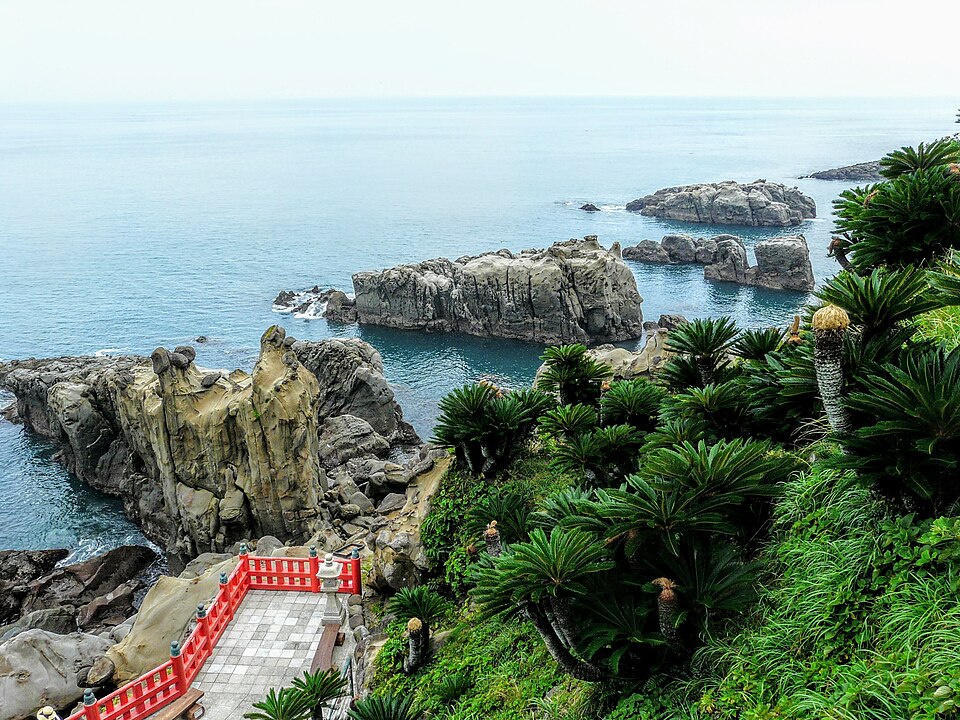
The founding vision of Aisu was not a tengu. This is the part of the standard narrative most often misreported in English-language sources. Aisu Ikōsai retreated to the cave at Udo Jingū (鵜戸神宮) in Hyūga (modern Miyazaki), and the deity who appeared to him in vision was — depending on the source — either a monkey (猿) or a spider (蜘蛛), not a tengu. The Udo Jingū Wikipedia entry preserves the canonical version: on the dawn of the fulfillment-day of his vow, he attained a new sword-method by facing a shadow crossing in front of him; that shadow was of a monkey upon which a deity had alighted to make him realize the deepest secrets. The Shūyūkan version gives the spider variant: Aisu Ikōsai Hisatada crossed to Hyūga and was given the secret transmission by a deity transformed into a spider (蜘蛛に化身した神). Both versions agree on the structural point: the deity manifested as a shadow (影) crossing the path, which is the etymology of Kage-ryū (陰流, "Shadow School") itself.
The "tengu" naming of Tengushō is therefore likely secondary to Aisu.
The bridge is most plausibly through Sarutahiko (猿田彦) no Mikoto, the long-nosed monkey-deity of Japanese mythology who is also a guide-figure (Ninigi's escort during the tenson kōrin) and who in medieval folk-religion is one of the standard identifications of tengu — the iconographic high-nose tengu image draws heavily on Sarutahiko's takanose (高鼻) attribute. Sarutahiko is one of the seven Ō-kami of Japan and is a figure symbolizing misogi, strength, and guidance. His jeweled spear illuminates the earth and sky.
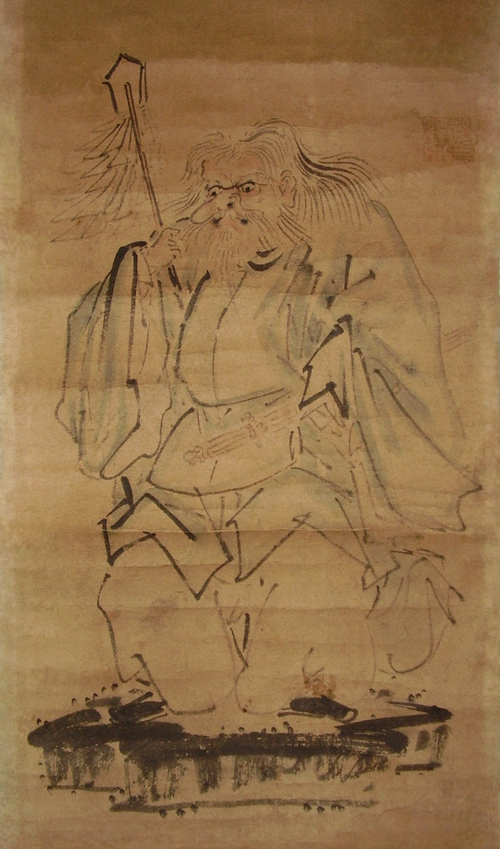
So it could be that the founding-vision of a monkey's shadow becomes sarugami (monkey-deity) and then Sarutahiko (long-nosed monkey-tengu) and then tengu more generally. By the time the set had a stable name, it was Tengushō — but the original mythic encounter was with a shadow monkey-form. The Tengushō name might also have been applied to the set later than its first transmission, perhaps by Kamiizumi himself, by which point the monkey-original had drifted into a tengu-frame in popular religious imagination.
The pre-Heisei understanding of Aisu Kage-ryū as essentially a reconstruction from Chinese sources (the Bubishi materials) genuinely shaped what people thought Kage-ryū looked like. The Tokyo National Museum Aisu Kage-no-ryū Mokuroku changed this in the early Heisei period and is still being absorbed into the secondary literature.
The Tengushō set is a Kage-ryū inheritance predating Sekishūsai's Yagyū-line refinements; the name traces back to Aisu Ikōsai's founding vision in the cave at Udo Jingū, though the vision itself was canonically of a deity-possessed monkey or spider, not a tengu — the tengu naming likely entered later in the concealment strategy associated to Sekishūsai's makimono and are likely not related to the kata themselves or specific Tengu one might contact or summon as part of a Tengushō practice attempting to recreate the vision or inspiration of Aisu.
Kata Arrangements
The Shūyūkan source states explicitly that the Aisu Kage-ryū secret techniques transmitted by Yagyū Ie-nobu include the Empi of the famous Eimokuroku, the Empi-oku set including Shishi Funjin and Yamagasumi, and the Tengushō Tachi-kazu Kamae Hachi, which is of Kage-ryū origin (陰流由来). Both Empi and Tengushō belong to Aisu's transmission and trace to the Udo Iwaya revelation. The set Shinkage-ryū calls Empi (燕飛, "swallow flying") was originally called Saruhi (猿飛, "monkey flying") in Aisu's Kage-ryū. The Bubishi-recorded "Kage-ryū Mokuroku" contains tachi-names including Saruhi (猿飛) and Sarukai (猿回) as opposed to the later Empi and Enkai naming used in later Yagyū Shinkage-ryū.
Empi-oku (Shishi Funjin or "lion's frenzy" and Yamagasumi or "mountain mist") are also listed in the Bubishi but not explicitly written in later Yagyū makimono — a blank space is left where they would be written, part of the concealment efforts associated to upper-level teachings. These two kata in modern practice involve techniques practiced against ryōto (dual sword), several other counters against ryōto are also found in Tengushō.
The rename from Saruhi to Empi was Kamiizumi's editorial decision when constructing Shinkage-ryū — a deliberate distancing from the monkey-vision origin in favor of a more abstract image (swallow flight). This homage may be due to Kamiizumi's time training with teachers who were influenced by the teachings of Iisaza Choisai of Shintō-ryū — shinmyō-ken and tsubame-gaeshi (swallow reversal) are important upper-level teachings of that art, which may be encoded in Kamiizumi's synthesis.
Shinmyō-ken
The official Kashima city documentation traces the entire Kashima martial tradition to a single divine revelation: Kuninazu Mahito built an altar at the Takamagahara within Kashima Jingū, offered fervent daily prayer, and is said to have received the principle of "Shinmyō-ken no Kurai" (神妙剣の位) — the law of the deity Takemikazuchi's divine sword Futsu-no-Mitama-no-Tsurugi — and this is said to be the origin of Japanese martial arts. The teaching was transmitted in the Yoshikawa family as "Kashima no Tachi," developing through "Kashima Jōko-ryū" and "Kashima Chūko-ryū" successively.
Kibejiro similarly states that offering fervent prayer he received divine oracle, and was granted the Shinmyō-ken no Kurai which is the law of Takemikazuchi's divine sword Futsu-no-Mitama; thereafter this was called "Kashima no Tachi" and was transmitted centrally through the Urabe-Yoshikawa family of the daigyōji headship.
Shinmyō-ken is not just a concept at Kashima — it is the originating concept of the entire Kashima martial lineage, the direct divine transmission from the war-god Takemikazuchi. Any swordsman emerging from that lineage would have Shinmyō-ken as a central, weighted term. Sekishūsai naming the supreme Okugi kata Shinmyō-ken is therefore extremely unlikely to be coincidence: it is the highest possible terminological homage to the Kashima foundation, applied to the highest kata of the Shinkage-ryū curriculum. The Kashima tradition's other foundational concept beyond Shinmyō-ken is the Hitotsu no Tachi (一の太刀, "One Sword"), which Bokuden transmitted to Kamiizumi according to some sources, and some teachers today relate to the concept of tsubame-gaeshi (燕返し, swallow-return).
The standard tradition lists Kamiizumi as one of Iizasa Chōisai's "Four Heavenly Kings" (四天王) disciples, alongside Matsumoto Bizen-no-kami, Tsukahara Tosa-no-kami, and Moroioka Ippa. But Iizasa Chōisai died in 1488 and Kamiizumi was born around 1508 — they could not have actually trained together. The realistic transmission path is likely via Matsumoto Bizen-no-kami and then to Kamiizumi — as claimed in Jiki Shinkage-ryū lineage.
From the rekishijin:
From an early age, seeking to learn military arts which he had been interested in since childhood, Nobutsuna travelled to Kashima and studied sword and spear under Matsumoto Bizen-no-kami Masanobu. Matsumoto Bizen was also Tsukahara Bokuden's teacher. After Matsumoto Bizen, Nobutsuna learned the "Kage stream" from Aisu Ikōsai's son Koshichirō, who was living in Hitachi.
Given Kamiizumi was steeped in Kashima-Katori teachings, his rename of Aisu's Saruhi (猿飛) to Empi (燕飛) carries additional weight. The swallow is a Kashima-region motif — birds appear throughout the Kashima/Katori iconographic and naming pool — and the swift, low, reversal-capable flight of the swallow expresses something quite different from the high, leaping monkey-vision of Aisu's revelation. Kamiizumi's rename can be read as the first stage of re-grounding Aisu's mountain-cave shadow-swordsmanship into the more strategically systematic eastern tradition. The choice of bird-imagery (swallow rather than, say, eagle or crane) over the monkey-imagery is then doing real synthesizing work: keeping the flight concept (which Aisu's Saruhi already carried) while exchanging the founding-revelation iconography (mountain monkey) for an iconography more at home in the Kashima-Katori-influenced curriculum Kamiizumi was building.
There remains, however, a tension in primary sources. The Shūyūkan attributes the Tengushō set to Aisu's transmission unambiguously, and the Yagyū commentary tradition supports this. But the Bubishi mokuroku (the Ming Chinese copy of an early Kage-ryū document) lists Saruhi, Sarukai, Yamakage, and other monkey-and-shadow-themed names — but does not list the Tengushō kata names (Kasha, Akemi, Zentai, etc.) The eight Tengushō kata names we know today are first reliably attested in late-Sengoku Yagyū documents.
Kuka, in contrast to Empi, is Kamiizumi's contribution, added when he reorganized the curriculum into the Shinkage-ryū structure. Kuka is said to contain teachings that counter the inner teachings of three contemporary ryūha: Shintō-ryū, Nen-ryū, and Chūjō-ryū. The 1566 Eimokuroku transmitted to Sekishūsai contains his self-description: "In antiquity there were ryū. In the middle period there were Nen-ryū, Shintō-ryū, and Kage-ryū. Beyond these are too many to count. I exhausted the deep sources of various ryū, and from Kage-ryū in particular extracted a separate marvel, naming it Shinkage-ryū." Kamiizumi identifies Nen-ryū, Shintō-ryū, and Kage-ryū — the Hyōhō Sandai Genryū — as the traditions he engaged with before composing Shinkage-ryū
Sangakuen also is an explanatory set developed by Kamiizumi that helps prepare a student for the later practice of Empi, and is said to counter the five basic teachings (itsutsu-no-tachi) of Shintō-ryū. The Sangakuen-en no Tachi in Owari Yagyū consists of five kata: Ittō Ryōdan, Zantei Setsutetsu, Hankai Hankō, Usen Saten, and Chōtan Ichimi. The five-kata structure mirroring Shintō-ryū's Itsutsu-no-Tachi (五ツノ太刀)
Concluding Remarks
We see in the case of Kamiizumi, a reframing of Aisu's monkey-inspired imagery from Sarutahiko towards swallow-based imagery more closely associated with Kashima. We then later see an abtraction of kata names in the Okugi developed by Sekishūsai to lean heavily on abstract Zen imagery — however, the culminating Okugi of shinmyō-ken circles back to the high-level teachings of Kashima as a source.
Kamiizumi's Eimokuroku declares his curriculum the synthesis of three traditions — Nen-ryū, Shintō-ryū, and Kage-ryū — and his documented training chain shows engagement at depth with each: directly from Matsumoto Bizen-no-kami Masanobu (Iizasa Chōisai's senior student) for the Shintō-ryū inner teachings including Shinmyō-ken, and from Aisu Koshichirō (Aisu Ikōsai's son) for the Kage stream. His own contributions to the Shinkage-ryū curriculum — Sangaku-en no Tachi (the five preparatory kata) and Kuka no Tachi (the nine principal kata) — are structurally organized as counter-curricula to the Shintō, Nen, and Chūjō traditions, with the Sangaku's five-kata structure paralleling Shintō-ryū's Itsutsu-no-Tachi. The Aisu inheritance (Empi, Tengushō) was preserved and refined rather than countered; the new kata were the strategic offensive material composed to defeat contemporary rivals.
In parallel development to Edo period Yagyū Shinkage-ryū, Yamada Heizaemon Ippusai and Naganuma Shirōzaemon Kunisato (長沼四郎左衛門国郷) of Jiki Shinkage-ryū lineage also put emphasis on Takemikazuchi and Kashima through the addition of the prefix Kashima-shinden to their art's name.
References
- 愛洲移香斎 (Wikipedia article on Aisu Hisatada). ja.wikipedia.org — Biographical entry on Aisu Hisatada (Ikōsai), 1452–1538; documents the Udo Iwaya retreat, the monkey-vision variant of the founding revelation, and the Aisu Sōtsū (Koshichirō) succession.
- 陰流 (Wikipedia article on Kage-ryū). ja.wikipedia.org — Documents the Bubishi-preserved Kage-ryū mokuroku containing Saruhi (猿飛), Sarukai (猿回), and Sankage (山陰); records the tradition that Shinkage-ryū's Empi is Kage-ryū's Saruhi renamed.
- 日向・鵜殿岩屋で開眼した「陰流」の始祖<愛洲移香斎>. 歴史人, 16 October 2023. rekishijin.com — Detailed biographical treatment of Aisu Ikōsai including the 1483–1485 Ming voyage chronology and the 37-day Udo retreat narrative.
- 伝説の剣豪・剣士・剣の達人を紹介【愛洲移香斎】. おもしろきこともなき世をおもぶろぐ. samurai-hi.com — Preserves both founding-vision variants (monkey at day-of-fulfillment, spider on night 21) and dates Aisu's reception of the secret transmission to Chōkyō 1 (1487).
- 陰流 - 黒田藩傳 柳生新陰流兵法 修猷館. syuyukan.jimdofree.com — Records the spider-revelation variant; documents the Yagyū Ie-nobu transmission of Empi, Empi-oku (Shishi Funjin, Yamagasumi), and Tengushō as "Kage-ryū origin" (陰流由来).
- 天真正伝香取神道流 (Wikipedia). ja.wikipedia.org — Lineage and kata inventory; lists Kamiizumi Nobutsuna, Matsumoto Bizen-no-kami, Tsukahara Tosa-no-kami, and Moroioka Ippa as Iizasa's "Four Heavenly Kings."
- 武術 天真正伝香取神道流. 千葉県教育委員会. pref.chiba.lg.jp — Official prefectural cultural-property documentation of Katori Shintō-ryū lineage including Kamiizumi's listing as a senior disciple.
- 天真正伝香取神道流剣術. 日本古武道協会. nihonkobudokyoukai.org — Nihon Kobudō Kyōkai documentation of the school; preserves the Iizasa founding-revelation narrative (千日修行 at Umegisan Fudansho, divine scroll from the Katori deity).
- 天真正伝神道流. コトバンク (Nipponica entry). kotobank.jp — Encyclopedia entry documenting the Matsumoto Bizen-no-kami Masanobu and Tsukahara Tosa-no-kami Yasumoto branches descending from Iizasa.
- 鹿島新當流. 鹿嶋市ホームページ. city.kashima.ibaraki.jp — Official Kashima city documentation: locates the origin of Japanese martial arts in Kuninazu Mahito's reception of the "Shinmyō-ken no Kurai" (神妙剣の位) — the law of Takemikazuchi's divine sword Futsu-no-Mitama — at the Kashima Jingū Takamagahara altar.
- 香取神道流は関東七流に含まれるのか. 木部二郎, note.com. note.com/kibejiro — Detailed analysis citing Imamura Yoshio's Nihon Budō Taikei vol. 1 on the Kashima/Katori distinction and the Kantō Shichi-ryū tradition; preserves the Shinmyō-ken origin narrative.
- 剣聖と東国三社. にわか狂言侍, 15 September 2018. ottocomae.net — Documents the Bokuden lineage and the Matsumoto Bizen → Bokuden transmission; useful for Bokuden's role in Kashima Shintō-ryū consolidation.
- 柳生石舟斎に剣技を伝えた「新陰流」の祖<上泉信綱>. 歴史人. rekishijin.com — Critical for the Kamiizumi training chain: documents direct study under Matsumoto Bizen-no-kami Masanobu (sword and spear) at Kashima, followed by Kage-ryū study under Aisu Koshichirō in Hitachi.
- 新陰流 (Wikipedia). ja.wikipedia.org — Preserves Kamiizumi's Eimokuroku self-attestation: "上古、流有り。中古、念流、新当流、また陰流有り… 予は諸流の奥源を極め、陰流において別に奇妙を抽出して新陰流を号す."
- 兵法三大源流 (Wikipedia). ja.wikipedia.org — Documents the Hyōhō Sandai Genryū framework (Kage-ryū, Shintō-ryū, Nen-ryū) and its derivation from Kamiizumi's 1566 Eimokuroku passage.
- 新陰流の世界 【参学円之太刀】. 剣と体術の世界 (はてなブログ), 2 June 2020. koshirae.hatenablog.com — Owari Yagyū practitioner exposition of the Sangakuen-en no Tachi five-kata structure and its place in the curriculum.
- 肥後・新陰流の形. 肥後・新陰流兵法 東京稽古会. sites.google.com/site/higoshinkageryutokyo — Hizen/Higo-line comparison of the Aisu Kage-ryū catalog (11 kata: Saruhi, Sarukai, Sankage, Tsuki-kage, Ukibune, Uranami, Shishi Funjin, Yamagasumi, Inken, Seigan, Samidare), Hikita Toyogorō's Saruhi-no-Mokuroku (6 kata), and Kamiizumi-to-Sekishūsai Empi (6 kata, with the last two reordered).
- 「疋田新陰流」と「柳生新陰流」. 疋田閃, note.com, 31 March 2025. note.com/hikita_chan09 — Side-by-side curriculum comparison: full Owari Yagyū catalog (Sangakuen, Kuka, Empi, Tengushō, Okugi, Hakka Hisshō) versus the Higo Hikita Shinkage-ryū curriculum (Sangaku, Ranko, Matsukaze, Kasha, Chōtan-tettei, Sappi, Tengusho, etc.) — useful for identifying which kata-sets are line-specific versus shared.